
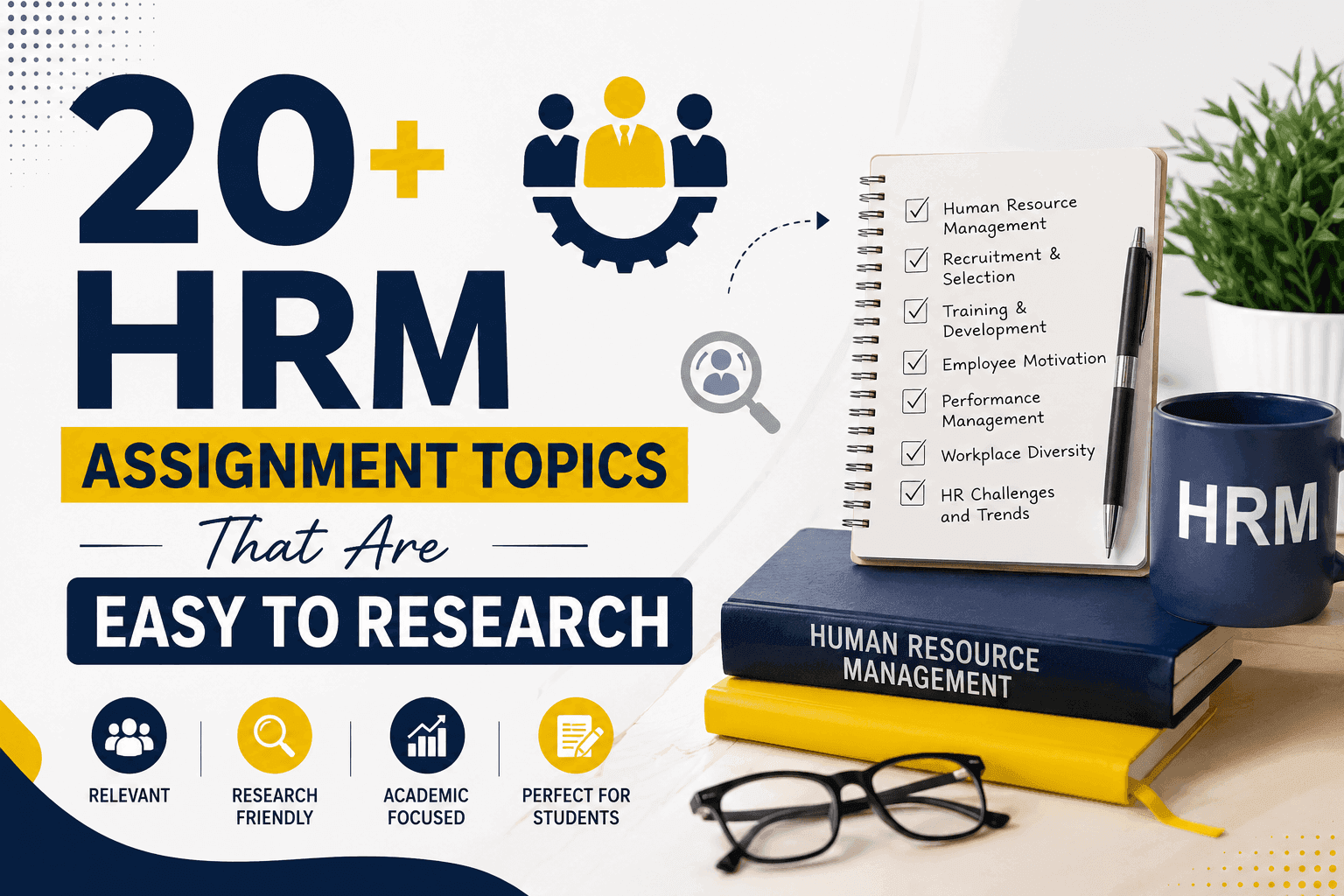
20+ HRM Assignment Topics That Are Easy to Research
Most HRM modules hand you the same instruction: pick a topic relevant to the course. That’s it. No list, no examples, no hint about what “relevant” actually means to the person grading it. So you sit there scrolling through your lecture slides, treating every topic as equally safe, when the opposite is true. A broad topic like “Recruitment in HRM” gives you nowhere to go, no argument to build, no gap to point at, nothing for your professor to mark beyond whether you summarized the textbook correctly.
The students who score well aren’t smarter or more experienced. They’ve just learned that a good topic does half the work before you write a single sentence. It hands you a built-in question, a clear angle, something to actually say. This guide skips the vague advice and gives you over thirty topics organized by HRM function, plus a simple way to turn any of them into something your assignment can genuinely stand on.
Why Your Topic Choice Quietly Decides Your Grade
Most students assume grading starts with the writing. It doesn’t. An examiner can usually tell within the first paragraph whether a topic was chosen with any thought or just lifted from the first search result that matched the assignment brief. A topic that’s too generic locks you into summarizing what’s already in the textbook, because there’s no room left for an actual argument. A topic that’s too narrow does the opposite. You run out of things to say by your third paragraph and start repeating yourself with different wording.
There’s a quick way to test any topic before you commit to it: try writing three sub-questions under it in two minutes. If you can’t, the topic is either too broad or too thin, and no amount of good writing will fix that later. Every topic in this list was chosen to pass that test, with enough room for the kind of independent analysis that Singapore’s HRM modules tend to reward.
Studying HRM in Singapore as an International Student
If your professor’s expectations feel unfamiliar compared to back home, that’s not just in your head. Singapore has become a major destination for international business and HRM students largely because of its private institutions that offer UK- and Australian-affiliated degrees. Many of the Best Private Universities of Singapore follow grading rubrics built around independent argument, primary research, and strict citation discipline, academic habits that aren’t always part of an undergraduate background elsewhere.
What this means for you: The difficulty isn’t the subject itself. It’s two challenges arriving at once. Adjusting to a new academic culture while also trying to pick a topic that fits it. That combination is exactly why topic selection trips up international students more often than local ones.
The good news is that once you know what the rubric is actually looking for, choosing the right topic stops being guesswork. That’s what the rest of this list is built for.
Recruitment & Talent Acquisition Topics
These topics work because each one has a built-in tension or a measurable trend to investigate, not just a function to describe.
- AI in candidate screening and bias risk
Looks efficient on the surface, but raises a real question about whether automated screening filters out qualified candidates unfairly. - Employer branding aimed at Gen Z talent
Lets you compare what this generation actually values against what most companies still advertise. - The gig economy’s effect on full-time recruitment pipelines
Forces a direct comparison between two hiring models competing for the same talent pool. - Skills-based hiring replacing degree requirements
Gives you a clear before-and-after shift to analyze, backed by growing industry data. - Recruitment analytics and predictive hiring
Opens up a discussion on whether data can really predict job performance, or just past hiring patterns. - Internal mobility versus external hiring costs
A practical cost-comparison angle that most companies are actively rethinking right now.
Employee Engagement & Retention Topics
This category gives you room to pull from psychology, data, and workplace culture all at once.
- Quiet quitting and disengagement metrics
Examines whether this trend is a new behavior or just an old problem finally being measured.
- Hybrid work’s effect on team cohesion
Compares how connected employees feel under remote, hybrid, and in-office setups.
- Financial wellness programs and retention
Looks at whether helping employees manage money actually keeps them from leaving.
- Generational differences in defining “engagement”
Explores why one survey question can mean completely different things to a 25-year-old and a 50-year-old employee.
- Exit interview data as a retention tool
Questions whether companies actually use this information or just collect it for the file.
- Employee voice and grievance mechanisms in multinational firms
Examines how well complaint systems work across different countries and cultures within the same company.
Performance Management & Compensation Topics
This category rewards comparison-style thinking, since pay and performance are two areas where companies are actively changing direction.
- Pay Transparency Laws and Internal Equity
New disclosure rules are forcing companies to defend pay gaps they used to keep quiet about, which opens up a strong angle on fairness versus business tradition.
- Performance Reviews vs Continuous Feedback Models
The annual review is steadily losing ground to ongoing check-ins, and there’s genuine debate over which approach actually improves performance over time.
- Pay-for-Performance Risks in Collectivist Work Cultures
A reward system built around individual achievement doesn’t always translate well into workplaces where success is measured as a group effort.
- Compensation Benchmarking Across ASEAN Markets
Salary data tells a very different story once you compare it across borders instead of staying within one country’s figures.
- AI-Assisted Performance Scoring and Fairness Concerns
Software can track output with ease, but whether it can judge performance fairly is still very much an open question.
- The Shift Away From Annual Appraisals
Companies are quietly dropping the once-a-year review model, and the reasoning behind that shift gives you plenty to analyze
Training, Diversity & Future-of-Work Topics
This category covers where HRM is headed next, which makes it a strong choice if your module rewards forward-looking analysis.
- Reskilling Programs for Automation-Displaced Roles
As certain jobs get phased out by automation, companies are scrambling to retrain employees instead of simply replacing them, and that transition is full of gaps worth examining.
- DEI Policy Implementation Gaps
Most companies have a diversity policy written down somewhere. Far fewer can show it actually changing who gets hired or promoted.
- Cross-Cultural Training for Multinational Teams
Training one team across multiple countries sounds simple until you account for how differently feedback, hierarchy, and communication are read in each culture.
- Microlearning vs Traditional L&D
Short, app-based learning modules are replacing long training sessions, and there’s a real question of whether they actually retain better or just feel more convenient.
- Neurodiversity Inclusion in Hiring Practices
Many hiring processes are still built around a narrow idea of what a “strong candidate” looks like, leaving neurodivergent applicants screened out before they’re even considered.
- Four-Day Workweek Pilots and HR Policy Adaptation
Shorter workweeks are being tested across industries, and HR departments are left figuring out how existing policies need to bend to support it.
Turning Any Topic Into a Real Question
Once you’ve picked a topic, the next step is to decide whether it actually works: turn it into a question that contains a built-in tension, not just a theme. “Diversity in hiring” gives you nothing to argue. “Why do diversity policies fail to change actual hiring outcomes in Singapore’s finance sector?” gives you something to prove. That single shift is usually the difference between a topic that reads like a summary and one that reads like research.
When a Simple Topic Gets Complicated
Some topics on this list look manageable right up until you actually start writing. Cross-cultural HRM comparisons, labor law across different countries, and multinational compensation benchmarking read like a straightforward essay on paper, but they quietly demand comparative data, case law, or sourcing from more than one country’s research. That scope rarely shows up until you’re already a few paragraphs in.
The 2 a.m. Panic Is More Common Than You Think
This is usually the moment a student opens a new tab and types “do my assignment” into Google, not because they were lazy about starting, but because the topic’s real size only became visible after the deadline got close. That panic search makes sense in the moment, but it rarely leads anywhere useful.
A Better Move Than a Random Search
Before reaching for the nearest search result, it helps to step back and get clarity on what the assignment actually needs first. That’s a far more useful next step than typing a desperate query at midnight, and it’s exactly what the next section walks through.
Is Asking for Help Actually Allowed?
This is a fair question, and most students never get a straight answer to it. International students are often juggling visa work-hour limits, citation formats that change between APA, Harvard, and Chicago depending on the module, and a reading load heavier than what they were used to before moving here. In that situation, seeking structured HRM assignment help isn’t about having someone else do the work. It’s about getting clarity on what the rubric is actually asking for before hours get wasted writing in the wrong direction entirely.
There’s a real difference between outsourcing an assignment and getting guided on how to approach it correctly. The second one is what actually protects your grade, and it’s a completely reasonable thing to look for when the expectations around you keep shifting.
When Three Deadlines Land in the Same Week
This isn’t about one confusing topic anymore. It’s about three or four assignments stacking up at once, all due within days of each other. The real skill here isn’t writing faster. It’s figuring out which assignment actually needs deep original thinking and which one just needs a second pair of eyes to tighten the structure before submission.
Treat It Like Triage, Not Panic
Once you sort assignments that way, an assignment helper starts making a lot more sense as a workload-management tool rather than a shortcut. You save your own energy for the work that genuinely needs your thinking, and let support cover the parts that just need polish.
Where AI Actually Helps
AI tools are genuinely useful for brainstorming angles on a topic, checking if your outline has obvious gaps, or confirming there’s enough research available before you commit to a direction. The line gets crossed the moment AI is asked to produce the actual analysis. HRM assignments are graded on how well you connect theory to a real case or workplace context, and generic AI output rarely does that convincingly. Most universities also run AI-detection checks now, and writing that sounds generated tends to get flagged regardless of how the content was sourced. Use it to think faster, not to think for you.
FAQs
What are the best HRM assignment topics for students?
Specific, researchable topics tied to real workplace challenges like AI in recruitment or remote performance management. Score better than broad, generic ones.
How do I choose an HRM topic that scores well?
Pick a topic with a clear problem and enough literature to support it. The narrower your research question, the stronger your argument.
Can I get help with my HRM assignment without academic misconduct?
Yes. Guidance on structure, topic selection, or draft feedback is legitimate. Submitting work that isn’t yours isn’t.
Stop Browsing. Start Narrowing.
You have the list, you have the context, and the only thing standing between you and a defensible HRM topic is the decision you keep postponing. Pick one topic, write it at the top of a blank document, and spend twenty minutes turning it into a research question sharp enough to actually answer. Deadline pressure doesn’t clarify thinking. It just shrinks your options until only the bad ones are left. One topic, one question, today. Before the panic does the choosing for you.

Part of the content team at AssignmentHelper.com.sg, the author specializes in writing informative articles about assignments, research techniques, and academic productivity. The goal is to provide students with clear, practical guidance to improve their writing skills and overall academic performance.