
How to Write a Strong Introduction for an Assignment
Writing your assignment might not be as tough as it seems. The initial stage is generally relaxed. You have grasped the main issue. The only thing remaining is to write an introduction. However, the situation might be tense since you could be thinking about the background knowledge you need to provide to satisfy your educator.
The good news is that you don’t need any kind of complicated approach to give a good start. All you need to do is present the topic of your paper, outline its goal, and provide necessary details for readers to have a good understanding of what follows. Let’s break down how to do that.
How Do You Start an Assignment Introduction?
Start with the specific subject rather than making a broad statement that could apply to almost anything. For example, an opening such as Education has always been important in society does little to establish the direction of a paper.
A more focused opening immediately connects the reader with the actual issue being discussed. You can begin by:
- Introducing a relevant problem
- Mentioning a specific situation
- Raising a meaningful question
- Presenting a relevant fact or finding
- Establishing a useful piece of background
The opening should have a reason for being there. Harvard’s Writing Centre recommends using the introduction to frame the question or problem the assignment will address rather than relying on dramatic hooks or overly broad statements.
What Should Your Assignment Introduction Include?
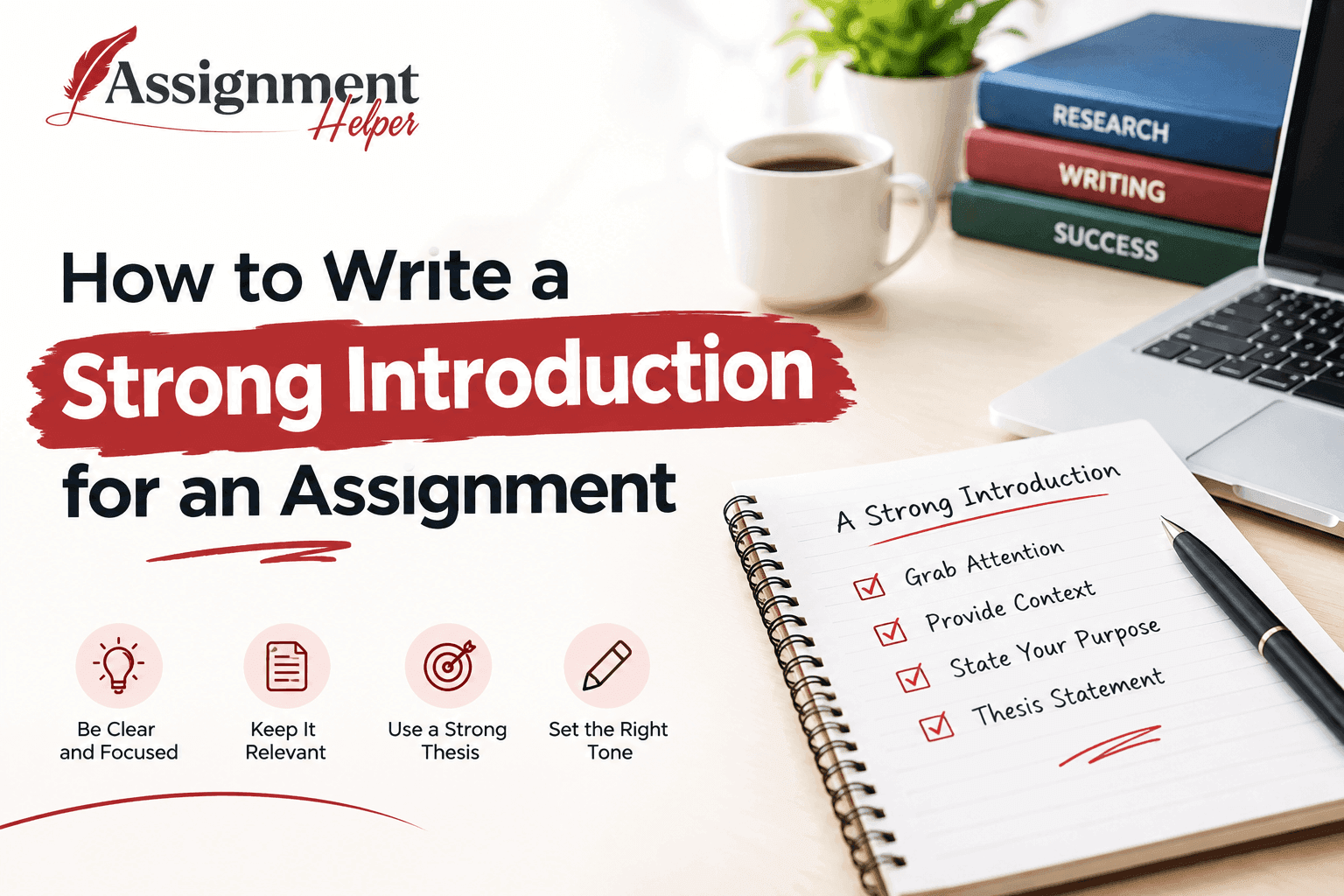
The introduction to an assignment should give the reader a sense of what the paper will be all about, give context to the topic and clearly state the purpose of the paper. It should not include everything that will be covered in the paper.
A useful introduction usually contains:
- A clear opening that introduces the subject
- Brief background or context
- The specific issue or question being addressed
- The purpose of the assignment
- A thesis statement or central argument
- A short overview of what the assignment will discuss, when appropriate
While there is no one formula that will work across all subjects, different disciplines may require different things and even assignments in the same discipline may have varying requirements.
How to Make Your Introduction Stronger?
Once the assignment is complete, read the introduction again alongside the body. Check whether the opening still matches what the paper actually discusses. Ask yourself:
- Does the introduction clearly identify the topic?
- Is the background relevant?
- Is the assignment’s purpose obvious?
- Does the thesis match the argument in the body?
- Have unnecessary details been removed?
- Does the introduction lead naturally into the first main section?
This final check is valuable because the introduction is not necessarily finished when the first draft is written. The argumentation in the introduction can change as the argument unfolds.
If you require help with structure, planning and academic writing, Assignment help SG can also be taken into consideration as an option, especially in cases when the problem lies in comprehending the way of doing the assignment and not the lack of writing skills.
Should You Write the Introduction Before the Body?
Not necessarily. In most cases, it is even more convenient to write an introduction after completing the main body of the assignment. Your opinion will evolve once you have completed the research and written the body. This can lead you to find out that some parts of your initial outline are less significant.
If you are tempted to search for something like write my assignment, remember that understanding the assignment question and developing your own argument can make the writing process much more manageable. That is why a useful approach is to:
- Read and understand the assignment question.
- Research the topic.
- Organise the main points.
- Develop the argument.
- Draft the body.
- Return to the introduction.
- Check that the introduction accurately reflects the finished assignment.
The University of Minnesota specifically notes that students may find it helpful to write the introduction later because the argument can become clearer as the paper develops.
How Long Should an Assignment Introduction Be?
There is no set number of words for an assignment introduction, as the length is determined by the assignment itself. In a short assignment, there is probably only going to be one sentence, but in a longer research assignment, more room will be required to create context and develop an argument.
According to the University of Michigan, it should be the right length according to the assignment length and purpose rather than being governed by one rule. It is best to check whether each sentence in the introduction helps the reader understand the assignment.
Remove sentences that:
- Repeat the same idea
- Provide unnecessary history
- Use complicated wording without adding meaning
- Explain evidence that belongs in the body
- Make claims unrelated to the assignment question
If removing a sentence does not make the introduction less clear, it probably does not need to stay.
What Introduction Writing Mistakes Should You Avoid?
Even when the research is strong, certain introduction mistakes can make an assignment feel unfocused.
Starting with a Cliché
Avoid openings that could be used for hundreds of unrelated assignments. They take up space without establishing your actual topic.
Giving Too Much Information
Your introduction should not contain every definition, statistic, example, or source you found during research. Save detailed evidence for the body.
Hiding the Main Argument
If the reader has to finish several paragraphs before understanding what the assignment is trying to establish, the introduction needs greater focus.
Repeating the Assignment Question
Just copying the assignment question into the introduction will not serve as an answer. If you are tempted to do my assignment for me, make sure you first understand what the question is actually asking. You have to come up with an answer to the assignment question.
Using the Introduction as the Summary of Your Work
It has been mentioned above that an introduction should set the ground for the discussion rather than give its summary. Such an approach is also stressed by the university writing guides.
Students Usually Ask
How many sentences does an assignment introduction have?
There is no specific number. Depending on the length of the assignment, you might have one sentence or a few. The main thing is to concentrate on providing all required background information and explaining the point of your paper.
Is it acceptable for the assignment introduction to have a question in it?
It is acceptable if the question has a direct relation to the assignment and helps to introduce the problem that is going to be examined. It is not appropriate to use rhetorical questions only to sound catchy.
Should the thesis statement come at the end of an introductory paragraph?
Not necessarily, because the location of a thesis statement depends on both the task at hand and the discipline of study, but often the thesis statement comes at the end as it makes for an easy transition from the introduction to the body.
Is it acceptable to revise the introduction after completing the assignment?
Yes, it is possible. After completing the assignment and revising the main part, you might want to change something in the introduction as well. During the writing process, your views might change.
To Conclude!
An effective introduction for any assignment does not necessarily have to be fancy and dramatic or loaded with complex vocabulary. An effective introduction provides a sense of direction to the assignment. Start by introducing the specific topic, include just enough background information that is needed, state the purpose of the assignment, and clearly state your thesis statement.
The most important thing to do is to ensure that the introduction fits the rest of the assignment that comes afterwards. This becomes much easier once the body of the assignment is written, since you now know exactly what the assignment is all about.

Part of the content team at AssignmentHelper.com.sg, the author specializes in writing informative articles about assignments, research techniques, and academic productivity. The goal is to provide students with clear, practical guidance to improve their writing skills and overall academic performance.